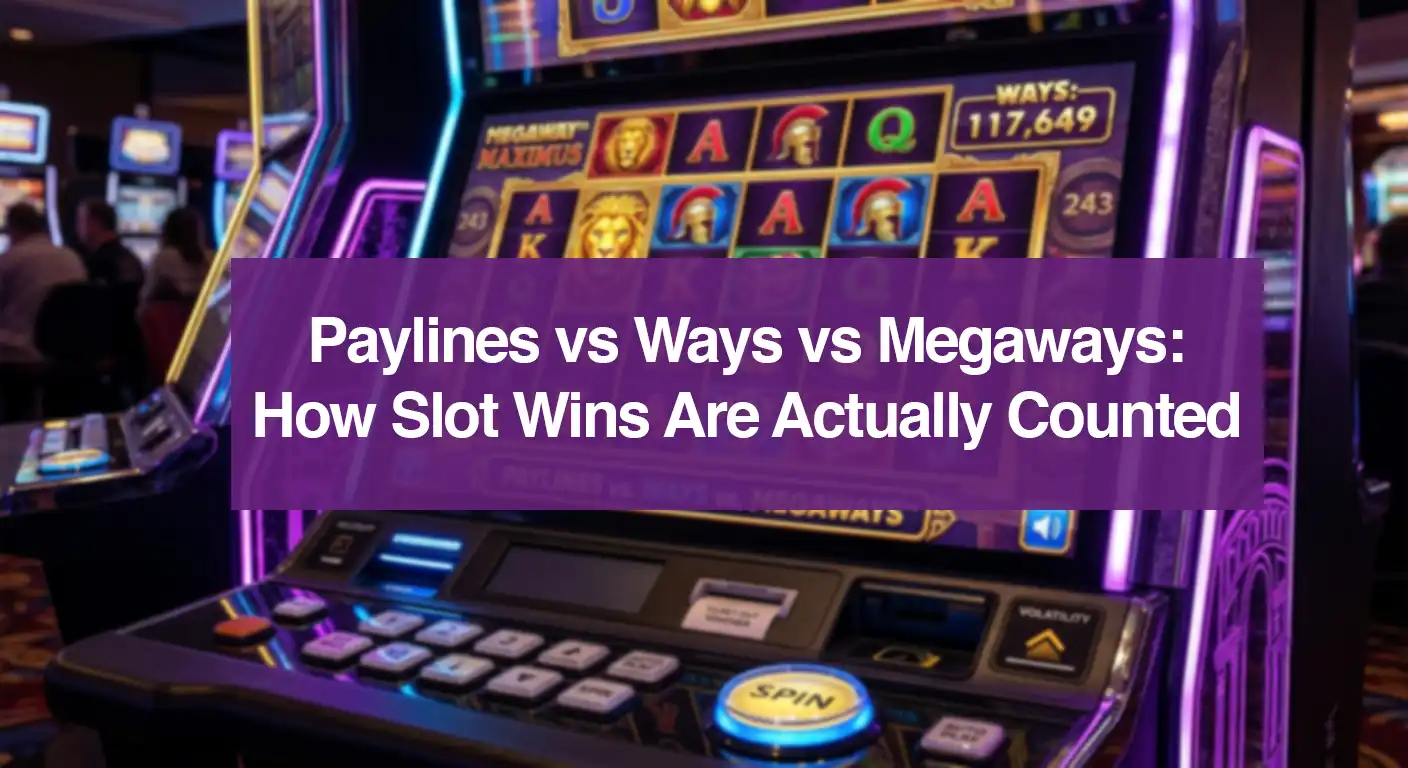
One slot displays “20 paylines”. Another advertises “243 ways”. A third proudly shows “up to 117,649 ways”. At first glance, these numbers seem to describe completely different games. In reality, they all refer to the same thing: the method a slot uses to count winning symbol combinations after the reels stop spinning.
The confusion starts because most players see the number but never see the logic behind it. Many assume that 243 ways means 243 chances to win, or that a larger number automatically changes the game’s generosity. Neither assumption is correct.
In this guide, we will break down paylines, ways to win, and Megaways step by step. You will see where numbers such as 243, 1024, and 117,649 come from, how each system works behind the scenes, and whether the counting method itself has any impact on your actual chances. You will be able to look at the slot interface and understand what these numbers mean.
Paylines: the classic way
A payline is a pre-set route across the reels, and a win is counted when matching symbols land along that route according to the game’s paytable. Think of it like noughts and crosses: a result only counts if it sits on a line the software is actually checking.
Classic machines began with a single centre line. The player was watching one clean path from left to right. If the right symbols landed on that path, the game paid according to the symbol value and sequence length. Simple. Very visible. Easy to follow.
Later, slot engines added more routes. Lines could run across the middle, top, bottom, diagonals, and zigzag patterns. That evolution gave players more visual activity on the screen, while still keeping the counting system fixed. The software was not checking every possible symbol position. It was checking the routes defined in the game file.
In many older line-based games, the number of active paylines could be adjusted. A player might switch some lines on or off, with the total stake changing because the bet was calculated per line. That is why old interfaces often showed “bet per line” and “number of lines” separately.
This also explains why line systems eventually reached a natural design limit. Once there are many overlapping routes, the screen becomes harder to read. More drawn paths do not automatically make the experience clearer. At some point, the visual line map becomes clutter not helpful.
From a software point of view, paylines are tidy. The engine checks fixed patterns and compares the landed symbols with the paytable. From a player’s point of view, the important point is this: the game only counts wins along enabled routes. Symbols outside those routes may look close, but they do not matter unless the rules say they do.
Ways to win: 243, 1024 and where the numbers come from
In a way to win the system, drawn lines disappear. A win is counted when matching symbols appear on neighbouring reels from left to right, on any visible position. The route is not a fixed line. It is any valid chain of matching symbols across adjacent reels.
This is where “243 ways” starts to make sense. Imagine a slot with 5 reels and 3 visible symbol positions on each reel. For a symbol to connect across all 5 reels, the software can choose one matching position from each reel. The position routes are counted like this: 3×3×3×3×3 = 243. That is the meaning of 243 ways.
Now change the visible height. If each reel has 4 symbol positions, the same idea becomes 4⁵ = 1024 ways. The counting logic is the same. There are simply more visible positions on each reel, so more possible position routes exist.
The key point is important: 243 ways does not mean “243 chances to win on one spin”. It means there are 243 possible position routes that the engine may check for qualifying symbol chains. Many players misunderstand this because the number looks like a promise. It is not. It is a map of possible routes.
The software evaluates results strictly against the paytable. To trigger a win, it requires matching symbols on adjacent reels starting from the designated side, while simultaneously applying special features, wild behaviour, and core design limits.
Ways-based games can feel easier to read because the player does not need to trace diagonal or zigzag lines. If matching symbols sit across neighbouring reels, the connection is usually easier to understand visually. The screen often feels more open because you are not asking, “Was that symbol on the active line?”
The ways-to-win system often triggers multiple small, connected payouts on a busy screen. This doesn’t mean you win more money overall. It simply alters how the results are displayed and how frequently you see winning combinations.
Think of paylines as fixed railway tracks across the reels, while ways are like connected stepping stones. Symbols simply need to land on neighbouring reels, rather than follow a pre-drawn path.
This is why the mechanic is often marketed as casino ways or simply ways to win. The system removes the mental task of checking line paths. The software still performs the same calculations, but the visual presentation feels easier to follow.
Megaways: when the reels change every spin
Megaways is a reel mechanic where the number of visible symbols can change with each spin. Therefore, the number of ways also changes from spin to spin. The game engine rebuilds the visible grid before each outcome evaluation.
This is why its interface often seems less predictable to the eye. One spin may show fewer visible positions on the reel, while another may show more. The counting system then multiplies the visible positions on the reels to calculate the available paths for that spin.
The headline number is up to 117,649. The maths behind it is straightforward: six reels, up to 7 symbols on each reel, gives 7⁶ = 117,649. That is the maximum route count under that structure. It is not the number present on every spin.
When the interface says “up to 117,649”, it means the route count can reach that ceiling when the reel layout allows it. On other spins, the number of active ways can be lower because the visible symbol count on each reel is different.
The mechanic was developed by Big Time Gaming and licensed to other providers. That is why Megaways releases can come from different studios while sharing the same core idea.
Many designs also feature cascading or reactive wins. Simply put, a winning set of symbols can be removed, or a new symbol will appear. This creates a rhythm that is different from a single static score.
The appeal of the mechanic is partly visual. The grid moves, the route count changes, and the screen can feel active even before the spin finishes. For players who enjoy watching systems unfold, that can be engaging. For players who prefer a clear, fixed structure, it may feel busier.
So, how does Megaways work in plain English? It changes the number of symbol positions on the reels, then counts ways using the visible positions for that spin. If cascades are present, the game may run extra evaluations after symbols are replaced.
A larger displayed route count does not, by itself, describe the return profile. It describes how many position routes the software can evaluate under that reel layout. RTP and volatility describe different things.
So which is better for the player?
The counting system itself does not make a slot more generous. Lines, ways and Megaways are ways of structuring the experience. The return profile is described through RTP and volatility, not by the route-counting label alone.
RTP means return to player. It is a theoretical long-term return figure built into the game model. It is not a prediction for a short session, and it is not a schedule of results. Think of it as a design parameter, not a steering wheel.
Volatility describes the character of payouts. A lower-volatility game usually feels steadier, with smaller results appearing more regularly. A higher-volatility game may feel quieter for longer, then produce sharper result swings. This is about distribution, not a promise about any single spin.
Hit rate is another useful concept. It describes how often a game produces any paying result over time. A game can have frequent small hits and still feel flat. Another can have fewer visible hits and still carry larger potential outcomes within its model. Again, the mechanic only shapes how the result is delivered and displayed.
The honest answer is therefore simple. Choose the mechanic because you prefer its feel, pace, and readability. Compare games by RTP and volatility when you want to understand the return profile. Do not assume the counting method alone tells the whole story.
If you like clean routes and visible structure, line-based games may feel comfortable. If you dislike tracing lines, ways to win may read more naturally. If you enjoy shifting reel grids and cascading rounds, Megaways may feel more dynamic.
Quick comparison: paylines vs ways vs Megaways
The fastest way to understand paylines vs ways vs Megaways is to compare what the software checks after the reels stop. The table below avoids rating one system above another. It simply shows how each engine counts valid symbol routes.
| Criteria | Paylines | Ways | Megaways |
| How a win is counted | Matching symbols land on fixed routes | Matching symbols appear on adjacent reels | Matching symbols appear on adjacent reels with changing reel heights |
| Typical structure | Fixed line map | Fixed the structure | Variable ways of structure |
| Does it change from spin to spin | Usually no | Usually no | Yes |
| Example number | 20–25 lines | 243–1024 ways | Up to 117,649 |
| What the player mainly reads | Drawn or hidden line paths | Symbol presence across reels | Reel height plus symbol presence |
| Best understood as | A route map | A position-route system | A dynamic position-route system |
A line game asks, “Did symbols land on the checked path?” A ways game asks, “Do matching symbols connect across neighbouring reels?” A Megaways game asks the same ways question, but with a reel grid that may change on every spin.
Spin them side by side
The quickest way to feel the difference between these mechanics is to compare them next to each other. A line-based slot feels structured. A ways game feels more open. A Megaways release feels more dynamic because the grid itself changes.
In Jack-Pot’s game library, players can move between classic slots with lines, ways-based games and Megaways releases without treating one format as a shortcut. The useful exercise is observation: watch how the engine reads the result, how the screen presents connections, and how the pace feels.
You can browse Megaways and classic slots at Jack-Pot through Jack-Pot’s game library. Use the comparison as a way to understand mechanics, not as a prediction tool.
FAQ
What does 243 ways to win mean?
243 ways means the game can count position routes across neighbouring reels. In the common layout, 5 reels have 3 visible positions each, so the maths is 3⁵ = 243. It is a route-counting structure, not a statement about a single spin outcome.
How does Megaways work?
Megaways changes the number of visible symbols on each reel before evaluating the spin. With six reels and up to 7 symbols per reel, the maximum route count is 7⁶ = 117,649. Some versions also use cascading results after a paying set is removed.
Are ways to win better than paylines?
Neither system is better by return logic alone. Ways to win change how symbol routes are counted, while paylines use fixed routes. RTP and volatility are the concepts to compare when you want to understand the return model.
Do more paylines change the game maths?
More paylines change how many fixed routes the software checks, and they may affect how the stake is structured in older formats. They do not, by themselves, define the return profile. Always read the game information panel for RTP and volatility context.